Bitcoin is the world's first successful cryptocurrency and the foundation of the modern blockchain industry. Today, thousands of cryptocurrencies—including Ethereum, Solana, and Binance Coin (BNB)—exist because Bitcoin proved that digital money could work without banks or governments controlling it.
If you're completely new to crypto, you may wonder:
- Who created Bitcoin?
- Why was it invented?
- What problems does it solve?
- How did it become worth thousands of dollars?
- Why is Bitcoin still the most important cryptocurrency?
This guide explains the complete history of Bitcoin in simple language, using real-world examples and analogies so anyone can understand it.
What is Bitcoin?
Before learning its history, let's understand what Bitcoin actually is.
Bitcoin (BTC) is digital money that allows people to send and receive payments over the internet without using a bank.
Imagine sending an email.
You don't need permission from your bank to send an email.
Similarly, Bitcoin lets you send money directly to another person anywhere in the world.
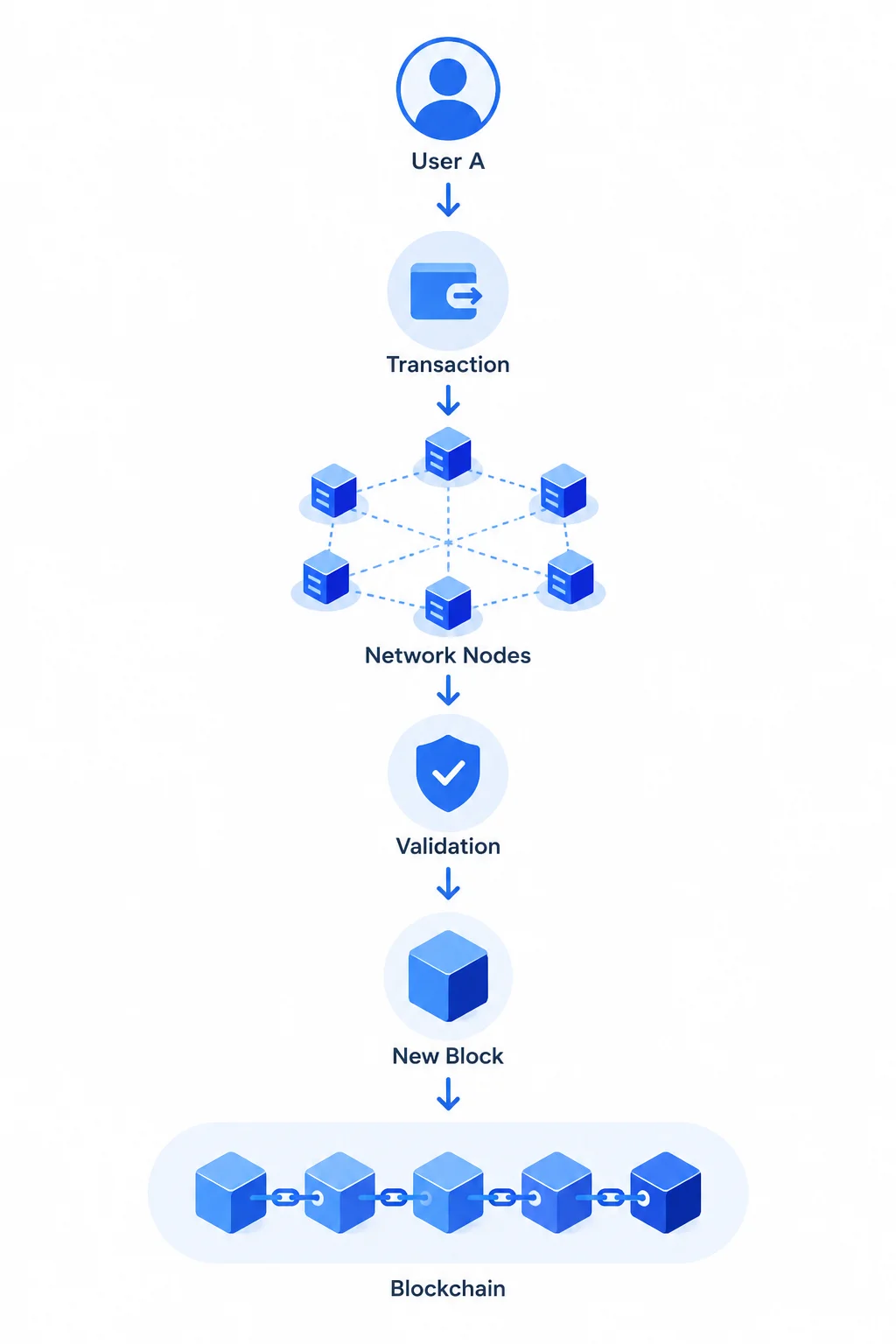
Instead of a bank keeping records, Bitcoin uses a technology called blockchain to record every transaction publicly.
Real-World Analogy
Think of a school notebook placed in the center of a classroom.
Everyone can see what is written.
Nobody can secretly erase old pages.
Whenever someone makes a payment, everyone writes it in their copy of the notebook.
This shared notebook is similar to the Bitcoin blockchain.
Why Was Bitcoin Created?
To understand Bitcoin's birth, we need to travel back in time.
Before Bitcoin
Before 2009:
- Banks controlled money.
- Governments printed currency.
- International transfers were expensive.
- Online payments relied on trusted companies.
- Financial institutions could freeze accounts.
People had no digital money that they truly owned.
The 2008 Financial Crisis
One of the biggest reasons Bitcoin became popular was the global financial crisis of 2008.
Banks made risky financial decisions.
Many banks failed.
Governments spent billions of dollars rescuing them using taxpayers' money.
Millions of people lost:
- Jobs
- Savings
- Homes
This made many people question whether the traditional financial system was fair.
Bitcoin offered an alternative.
Diagram (Described in Words)
Imagine a flow chart:
Traditional Banking
Person → Bank → Government → Another Bank → Receiver
Bitcoin
Person → Bitcoin Network → Receiver
Notice how Bitcoin removes several middlemen.
Who Created Bitcoin?
Bitcoin was created by a mysterious person (or group) using the name:
Satoshi Nakamoto
No one knows:
- their real identity
- where they lived
- whether they were one person or many
Satoshi communicated only through emails and online forums.
In 2008, Satoshi published a document called the Bitcoin Whitepaper.
It explained how digital money could work without banks.
The Bitcoin Whitepaper
A whitepaper is similar to a blueprint before building a house.
Before construction begins, architects create detailed plans.
Likewise, Satoshi created a plan explaining how Bitcoin would work.
The whitepaper introduced ideas like:
- blockchain
- proof of work
- decentralized payments
- digital scarcity
These ideas became the foundation of today's crypto industry.
Bitcoin Launches (2009)
On January 3, 2009:
Bitcoin officially launched.
The first block of the blockchain was created.
It is called the:
Genesis Block
Inside the Genesis Block was a hidden newspaper headline:
"The Times 03/Jan/2009 Chancellor on brink of second bailout for banks"
This message reminded people why Bitcoin existed—to provide an alternative financial system.
The First Bitcoin Transaction
Shortly after launch,
Satoshi sent Bitcoin to another developer:
Hal Finney
This became the first Bitcoin transaction.
Think of it like sending the first email ever.
It proved the technology actually worked.
Mining Begins
Bitcoin introduced an entirely new concept:
Mining
Mining means computers solve mathematical puzzles.
When solved:
- transactions are verified
- a new block is added
- miners receive Bitcoin rewards
Mining Analogy
Imagine solving Sudoku puzzles.
Each completed puzzle earns a gold coin.
The harder the puzzle, the fewer people can solve it.
Mining works similarly.
The First Real Bitcoin Purchase
One of Bitcoin's most famous moments happened in 2010.
A programmer named Laszlo Hanyecz bought:
2 pizzas
using
10,000 BTC
Today, those Bitcoins would be worth hundreds of millions of dollars.
This event is celebrated every year as:
Bitcoin Pizza Day
It proved Bitcoin could be used as real money.
Bitcoin Starts Growing
After the pizza purchase:
More developers joined.
More people mined Bitcoin.
Crypto exchanges appeared.
Communities formed online.
Bitcoin slowly gained attention worldwide.
What Makes Bitcoin Different?
Bitcoin introduced several revolutionary ideas.
| Feature | Traditional Money | Bitcoin |
|---|---|---|
| Controlled by | Governments | No central authority |
| Supply | Unlimited printing possible | Maximum 21 million BTC |
| Transactions | Bank required | Peer-to-peer |
| Open 24/7 | Depends on banks | Yes |
| Global | Limited | Worldwide |
| Public Ledger | No | Yes |
The 21 Million Bitcoin Limit
Bitcoin has a fixed supply.
Only:
21 million Bitcoins
will ever exist.
No one can create more.
Gold Analogy
Gold is valuable because it is scarce.
If gold could be printed like paper, it would lose value.
Bitcoin works similarly.
Scarcity creates value.
Bitcoin Halving
Every four years approximately,
Bitcoin mining rewards are reduced by half.
This event is called:
Bitcoin Halving
Example:
- 50 BTC
- 25 BTC
- 12.5 BTC
- 6.25 BTC
- 3.125 BTC
Reducing new supply helps maintain scarcity.
Diagram (Described in Words)
Picture a staircase going downward.
50
↓
25
↓
12.5
↓
6.25
↓
3.125
Each step represents a Bitcoin halving event.
Bitcoin Becomes Valuable
Initially:
1 BTC was worth almost nothing.
As more people believed in Bitcoin:
- demand increased
- supply remained limited
Prices began rising.
This follows a basic economic principle.
Higher demand + limited supply = higher prices.
Major Bitcoin Milestones
2008
Bitcoin Whitepaper published.
2009
Genesis Block created.
Bitcoin network launched.
2010
First Bitcoin purchase (Pizza Day).
2011
Bitcoin reached approximately $1.
2013
Bitcoin gained worldwide media attention.
2017
Bitcoin approached $20,000.
Millions of new investors entered crypto.
2021
Bitcoin reached new all-time highs above $60,000.
Large companies started buying Bitcoin.
Institutional investors entered the market.
2024–2026
Bitcoin continued evolving with broader institutional adoption, exchange-traded funds (ETFs) in several markets, ongoing regulatory developments, and increasing recognition as a long-term digital asset. Adoption continues to grow, though prices remain highly volatile.
How Bitcoin Inspired Other Cryptocurrencies
Bitcoin proved blockchain worked.
Other projects expanded the idea.
| Cryptocurrency | Main Purpose |
| Bitcoin | Digital money |
| Ethereum | Smart contracts and decentralized applications |
| Solana | Fast blockchain for applications and payments |
| Binance Smart Chain (BNB Chain) | Lower-cost smart contracts and decentralized finance |
Think of Bitcoin as the first smartphone.
Later companies improved different features.
Ethereum added programmable applications.
Solana focused on speed.
BNB Chain focused on affordability and ecosystem growth.
Bitcoin vs Ethereum vs Solana vs Binance Coin
| Feature | Bitcoin (BTC) | Ethereum (ETH) | Solana (SOL) |
|---|---|---|---|
| Consensus | Proof of Work (PoW) | Proof of Stake (PoS) | Proof of Stake (PoS) + Proof of History (PoH) |
| Transaction Speed | ~10 minutes per block | ~12 seconds per block | ~400 milliseconds per block |
| Average Fees | Moderate to high during network congestion | Can be high during peak demand | Very low (typically fractions of a cent) |
| Supply | Fixed at 21 million BTC | No fixed maximum supply (issuance is dynamic) | No fixed maximum supply (inflationary with ongoing token issuance) |
| Smart Contracts | ❌ No (very limited scripting) | ✅ Yes | ✅ Yes |
| TPS (Transactions Per Second) | ~7 TPS | ~15–30 TPS (Layer 1) | Up to thousands of TPS in practice (theoretical capacity is much higher) |
| Primary Market Use | Digital gold, store of value, peer-to-peer payments | Decentralized applications (dApps), DeFi, NFTs, smart contracts | High-speed dApps, DeFi, NFTs, gaming, payments |
| Launch Year | 2009 | 2015 | 2020 |
| Native Token | BTC | ETH | SOL |
| Typical Users | Long-term investors, institutions, payment users | Developers, DeFi users, NFT creators | Developers building high-performance applications and users seeking low fees |
Step-by-Step: How Bitcoin Changed the Financial World
Step 1
A person publishes an idea.
↓
Step 2
The Bitcoin network launches.
↓
Step 3
People begin mining.
↓
Step 4
Developers improve the software.
↓
Step 5
Businesses accept Bitcoin.
↓
Step 6
Exchanges allow buying and selling.
↓
Step 7
Institutions invest.
↓
Step 8
Bitcoin becomes a global financial asset.
Practical Example
Imagine Sarah in Canada wants to send money to Ali in Pakistan.
Traditional Banking
Sarah
↓
Bank
↓
International Payment Network
↓
Ali's Bank
↓
Ali
Time:
Several days
Fees:
Often high
Bitcoin
Sarah
↓
Bitcoin Network
↓
Ali
Time:
Often much faster (depending on network conditions)
Fees:
Can vary, but no bank is required.
Common Myths About Bitcoin
Myth 1
Bitcoin is fake money.
Reality:
Bitcoin is digital money secured by cryptography and a decentralized network.
Myth 2
Bitcoin is controlled by one company.
Reality:
No company owns Bitcoin.
Thousands of computers operate the network worldwide.
Myth 3
Bitcoin has unlimited supply.
Reality:
Only 21 million BTC will ever exist.
Myth 4
Bitcoin transactions can be changed.
Reality:
Confirmed transactions on the blockchain are designed to be extremely difficult to alter.
Common Beginner Mistakes
Buying without learning
Always understand Bitcoin before investing.
Believing every social media influencer
Not every online prediction is trustworthy.
Expecting quick profits
Bitcoin prices move up and down.
Patience is important.
Ignoring security
Protect your wallet and private keys.
Panic selling
Price volatility is normal in crypto markets.
Bitcoin Security Tips
- Never share your private keys.
- Store recovery phrases offline.
- Enable two-factor authentication (2FA) on exchange accounts.
- Verify website URLs before logging in.
- Beware of fake giveaways and phishing scams.
- Keep software and wallets updated.
- Consider using a hardware wallet for long-term storage.
Why Bitcoin Still Matters Today
Even after thousands of cryptocurrencies were created,
Bitcoin remains the largest and most recognized cryptocurrency by market value.
Many investors view Bitcoin as:
- Digital gold
- Long-term savings
- Inflation hedge (though this remains debated)
- Global payment network
- Foundation of blockchain innovation
Whether someone prefers Ethereum, Solana, or BNB Chain for their unique capabilities, Bitcoin remains the project that started the cryptocurrency revolution.
Frequently Asked Questions (FAQs)
Is Bitcoin legal?
It depends on the country. Some countries fully allow Bitcoin, some regulate it, while others impose restrictions. Always check your local laws before buying or using cryptocurrency.
Can Bitcoin be hacked?
The Bitcoin blockchain itself has proven highly secure over the years. However, exchanges, wallets, or users can be compromised if proper security practices are not followed.
Who owns the most Bitcoin?
Bitcoin ownership is spread across millions of wallets. Some of the largest holders include long-term investors, companies, investment funds, exchanges, and wallets believed to belong to Satoshi Nakamoto.
Can I buy less than one Bitcoin?
Yes.
Bitcoin is divisible into very small units.
You can buy a tiny fraction instead of one whole BTC.
Why is Bitcoin expensive?
Its price is driven by supply and demand. Since the total supply is capped at 21 million coins, increasing demand can contribute to higher prices.
Is Bitcoin anonymous?
Not completely.
Bitcoin transactions are publicly visible on the blockchain, but wallet addresses are represented by alphanumeric strings rather than personal names. This makes Bitcoin better described as pseudonymous, not fully anonymous.
Does Bitcoin have a physical coin?
No.
Bitcoin exists only in digital form.
Can Bitcoin replace banks?
Bitcoin enables peer-to-peer payments without banks, but whether it will replace traditional banking entirely is uncertain. Today, many people use both traditional financial services and cryptocurrencies for different purposes.
Summary
Bitcoin began as an idea during the 2008 financial crisis and launched in 2009 as the world's first decentralized cryptocurrency. Created under the pseudonym Satoshi Nakamoto, it introduced blockchain technology, digital scarcity, and peer-to-peer payments without relying on banks.
Over time, Bitcoin evolved from an experimental project used by a small group of enthusiasts into a globally recognized digital asset. It inspired thousands of other blockchain networks, including Ethereum, Solana, and BNB Chain, each building on the foundation Bitcoin established.
Understanding Bitcoin's history helps beginners appreciate why it remains the most influential cryptocurrency and why its design continues to shape the future of digital finance.